Beyond the Chief Complaint: What a Great Aesthetic Consultation Actually Reveals
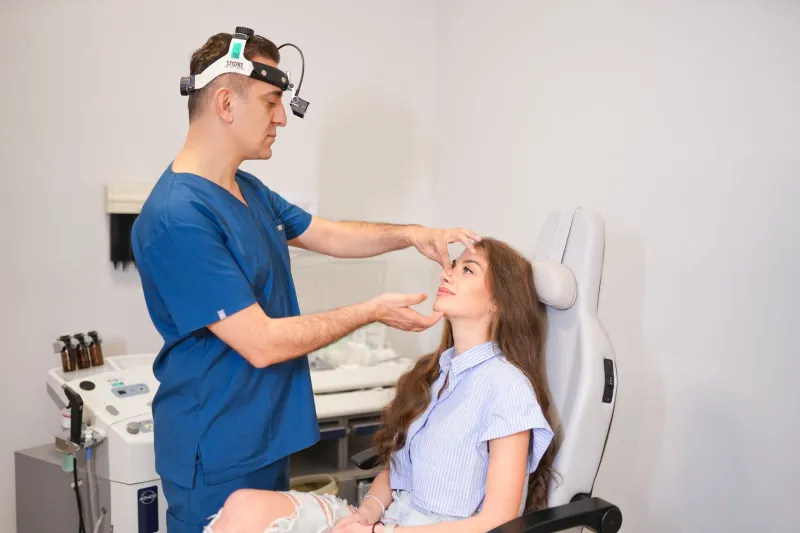
There is a particular kind of frustration that follows a cosmetic procedure when something still feels off. The wrinkle is gone. The volume has been restored. Technically, everything was addressed. And yet the face in the mirror doesn't look quite right—not wrong, exactly, but not better in the way you had imagined.
This experience is more common than most clinics would care to admit. And in the majority of cases, it doesn't trace back to poor technique. It traces back to a consultation that began and ended with the wrong question.
The Trap of the Targeted Complaint
When patients arrive at an aesthetic clinic, they typically come armed with a specific concern. A deepening nasolabial fold. A loss of definition along the jawline. A forehead line that photographs more severely than it looks in person. These are real observations, and they deserve to be taken seriously.
The problem arises when the consultation treats that single observation as both the diagnosis and the treatment plan. In transactional medicine—where the goal is to satisfy the presenting complaint as efficiently as possible—this is standard practice. A patient points to something; the clinician addresses it. Exchange complete.
But the face is not a collection of independent parts. It is a system of relationships. The way the midface sits affects how the jawline reads. The position of the brow influences the apparent depth of the under-eye area. Volume in the temples changes the perceived width of the upper face, which in turn affects how prominent the nose appears. Treating one element without understanding its relationship to the whole is like adjusting a single instrument in an orchestra and wondering why the piece still sounds unbalanced.
What Proportion Actually Means
Japanese aesthetic philosophy has long placed proportion at the center of beauty—not as a rigid mathematical formula, but as a dynamic sense of visual equilibrium. The concept of ma, the meaningful use of negative space, applies as readily to facial architecture as it does to garden design or ink painting. What is absent, understated, or unaltered is as important as what is treated.
At Aoki Aesthetic Clinic, this philosophy shapes how consultations are structured from the first moment. Rather than asking only "what bothers you," a skilled practitioner also asks: What do you want your face to communicate? How do you appear in photographs versus in person? Has the concern you're describing changed gradually, or did it seem to appear suddenly? What did your face look like five or ten years ago?
These questions are not incidental. They build a picture of how the face has aged as a whole—which structures have shifted, which have held, and where the visual center of gravity has moved. Without that picture, any intervention is, at best, an educated guess.
The Questions Patients Don't Expect
One of the most telling signs of a truly skilled aesthetic consultation is that it surprises the patient. Not in a disconcerting way, but in the way that a perceptive observation always does—with the quiet recognition that someone has seen something you hadn't quite articulated yourself.
A practitioner might note that the concern a patient has about their lower face is, in part, a consequence of volume loss in the upper cheeks—a change the patient hadn't registered consciously because it happened gradually. Or they might observe that the asymmetry a patient finds troubling is actually a long-standing feature of their anatomy, not a product of aging, and that correcting it would require a very different approach than the patient had assumed.
Sometimes the most important thing a consultation reveals is that the presenting concern is not the primary issue at all. This isn't a dismissal of the patient's perception. It's a reframing that opens the door to a more meaningful result.
Harmony Over Correction
The distinction between correcting and harmonizing is subtle but significant. Correction implies that something is wrong and must be fixed. Harmonizing implies that the goal is a more balanced relationship between existing features—some of which may be entirely intact.
This shift in orientation changes what gets prioritized. A practitioner thinking in terms of harmony might recommend addressing the midface before the lower face, even if the patient's concern is specifically about the chin. They might suggest a conservative approach to one area precisely because treating it aggressively would draw attention away from a more impactful opportunity elsewhere. They might recommend no treatment at all in a particular area, and explain clearly why restraint serves the patient's overall aesthetic better than intervention.
In the United States, where cosmetic consultations are often shaped by consumer expectations and a culture of direct problem-solving, this kind of nuanced guidance can feel unexpected. Patients sometimes interpret a practitioner's reluctance to immediately address the stated concern as hesitation or lack of expertise. In reality, it is frequently the opposite.
The Role of Time in a Good Consultation
A consultation that genuinely serves a patient cannot be rushed. This sounds obvious, but it has real implications for how clinics are structured and how practitioners allocate their time.
At Aoki Aesthetic Clinic, initial consultations are treated as a form of careful study—an opportunity to understand not only the anatomy in front of us, but the person within it. That means listening for what patients say and what they leave unsaid. It means asking about lifestyle, about how they see themselves, about what they hope aesthetic care will and will not change. It means being honest when a patient's expectations are misaligned with what a procedure can realistically deliver.
This takes time. And it is time well spent, because the alternative—a rapid consultation that produces a technically adequate result the patient doesn't feel good about—serves no one.
A Different Starting Point
If you are preparing for an aesthetic consultation, consider arriving with something beyond your specific concern. Bring photographs from several years ago, if you have them. Think about what you want your face to feel like to look at, not just what you want changed. Be open to the possibility that the practitioner may identify something you hadn't considered, or may gently challenge an assumption you've held for years.
The most valuable consultations are not the ones where every question is answered immediately. They are the ones where the right questions get asked in the first place.
At Aoki Aesthetic Clinic, that is where every conversation begins—not with a treatment, but with a genuine attempt to understand the full picture. Because beauty, in its most enduring form, is never about a single feature. It is about the relationship between all of them.