What the Clinic Records — Not the Patient — Is the Real Foundation of Lasting Aesthetic Results
Photo: Mennonite Church USA Archives, No restrictions, via Wikimedia Commons
There is a quiet assumption embedded in most American approaches to cosmetic care: that the patient is the primary keeper of her own aesthetic history. She saves her before photos. She tracks her treatment dates in a notes app. She arrives at each appointment ready to report what she noticed, what she liked, what she would change. This self-documentation is encouraged, even celebrated, as a sign of an engaged, informed patient.
But this framing, however well-intentioned, places the burden of clinical precision on the person least equipped to carry it. The patient sees her face daily, which means she sees it poorly — subject to lighting shifts, emotional states, and the well-documented psychological phenomenon of adaptation, wherein the brain gradually normalizes whatever it encounters most frequently. What she records is, inevitably, incomplete.
The more important question is not what the patient is documenting. It is what the clinic is.
The Difference Between a Visit Record and a Clinical Portrait
In conventional aesthetic practices, a patient visit generates a treatment note: what was done, how much product was used, where it was placed. This is a transactional record. It documents a service rendered.
Precision aesthetic medicine demands something fundamentally different — a clinical portrait. This is a longitudinal, layered document that captures not just what was done, but the structural and dynamic conditions under which it was done. It includes baseline skin analysis: texture, hydration levels, pigmentation patterns, and the behavior of the skin under varying conditions. It records muscle movement patterns, because the way a face animates is as diagnostically significant as how it appears at rest. It notes structural asymmetries — the slightly higher brow, the asymmetric jawline, the uneven nasolabial fold depth — that must be accounted for in any treatment plan that aspires to look natural rather than merely altered.
This kind of documentation is not a luxury. It is the clinical infrastructure on which every subsequent decision rests.
Why Asymmetry Records Matter More Than Patients Realize
Virtually every human face carries some degree of asymmetry. This is normal, expected, and in many cases, part of what gives a face its character. The problem arises when a clinician treats a face without a precise baseline record of its pre-existing asymmetries.
Consider a patient who presents after several years of neurotoxin treatments at a previous clinic. She is bothered by what she perceives as a new unevenness in her brow position. Without a documented baseline, it is nearly impossible to determine whether this asymmetry was always present, whether it developed gradually over time, or whether it was introduced or exacerbated by prior treatment. The absence of a clinical record does not just complicate the current visit — it erases the clinical history that would make accurate diagnosis possible.
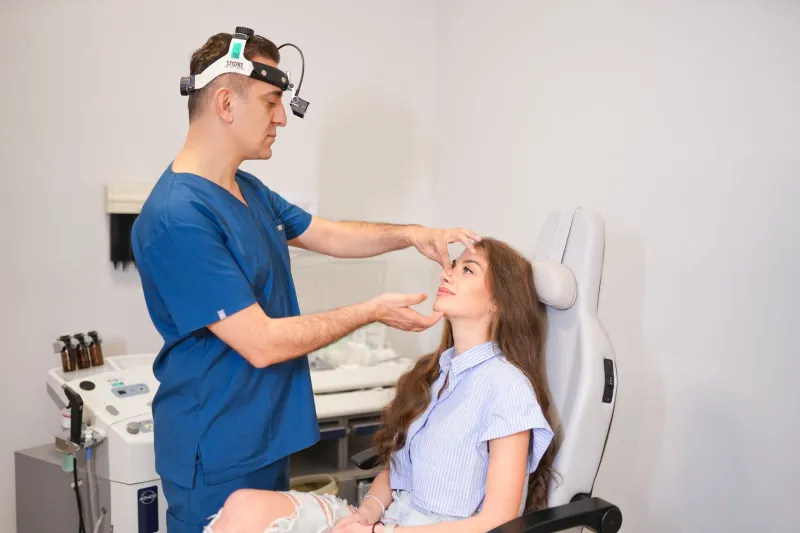
At Aoki Aesthetic Clinic, the initial consultation is structured specifically to establish this baseline with precision. Photographs are taken under standardized lighting and from consistent angles, not as a marketing exercise, but as a medical document. Muscle movement is assessed dynamically, not just at rest. These records do not belong to a marketing archive. They belong to the patient's medical file.
The Cumulative Nature of Aesthetic Medicine
One of the distinguishing principles of Japanese aesthetic philosophy is a commitment to outcomes that compound gracefully over time. This stands in contrast to the prevailing American model, which tends to treat each visit as a discrete event — a touch-up here, a refresh there — with little structural continuity between them.
Cumulative aesthetic medicine requires cumulative records. When a physician can review three years of documented skin behavior, treatment responses, and structural changes, she is not guessing. She is practicing. The difference between these two states is not subtle. It is the difference between a clinician who adjusts your treatment because she observed something specific in your file and one who adjusts it because she is following a general protocol.
Skin aging is not linear, and it is not uniform. The way collagen density changes in your forehead may bear little resemblance to how it changes along your jawline. The muscle activity that drives expression lines in your thirties may shift meaningfully in your forties. A physician without longitudinal documentation of these patterns is perpetually working from incomplete information.
What Rigorous Documentation Protects Against
Beyond enabling better outcomes, thorough clinical record-keeping performs a protective function that patients rarely consider until they need it.
It protects against over-treatment. When a physician can see exactly how a patient has responded to prior procedures — the precise volume used, the anatomical placement, the documented result — she has a clear basis for determining when additional treatment is appropriate and when restraint is the correct clinical choice. Without this record, the default often becomes: do more.
It protects against drift. Aesthetic drift — the gradual, incremental shift in a patient's appearance that occurs when small adjustments accumulate without a clear structural framework — is one of the most common and least-discussed complications in cosmetic medicine. It rarely results from a single decision. It results from the absence of a documented baseline against which each decision can be measured.
And it protects against the loss of institutional memory that occurs when patients change providers. A complete clinical record is portable in a way that subjective patient recollection is not.
What to Ask at Your Next Consultation
If you are evaluating an aesthetic clinic — whether for an initial visit or a transition from another provider — the quality of their documentation practices is a meaningful indicator of their clinical philosophy.
Ask how baseline skin analysis is conducted and recorded. Ask whether your muscle movement patterns are documented as part of your file. Ask how treatment decisions are referenced against your prior records. Ask whether the photographs taken at your visits are stored as medical documents or as marketing assets.
These are not bureaucratic questions. They are clinical ones. The answers will tell you whether a practice is oriented toward precision and continuity, or toward the transaction at hand.
The Quiet Standard Behind Every Lasting Result
The patients who achieve the most enduring, natural-looking aesthetic outcomes are rarely the ones who arrived with the most elaborate personal documentation. They are the ones whose physicians maintained the most rigorous clinical records — who treated each visit not as an isolated encounter, but as one data point in a carefully observed longitudinal study.
At Aoki Aesthetic Clinic, this approach reflects a foundational conviction: that aesthetic medicine practiced at its highest level is, first and foremost, medicine. The artistry is real. The technical skill matters. But neither can be applied with true precision without the clinical infrastructure that only thorough, sustained documentation provides.
The consultation you may not remember in five years will still be on file. That, in the end, is the point.