Your Face Is Not a Template: Why Facial Structure Should Drive Every Aesthetic Decision
There is a question that rarely gets asked in aesthetic consultations, and its absence explains a significant portion of patient dissatisfaction. It is not about downtime, cost, or recovery. It is this: Are the results you're imagining actually compatible with the face you have?
This is not a discouraging question. It is, in fact, the most empowering one a clinician can raise — because the answer shapes everything that follows. Japanese aesthetic medicine has long operated on the premise that a beautiful result is not a universal image applied to any willing face. It is a precise calibration between what a patient envisions and what their unique facial architecture can genuinely support.
The Anatomy Beneath the Aspiration
When patients arrive at a consultation with a photograph — a celebrity's jawline, an influencer's cheekbones, a before-and-after from a clinic's social media — they are bringing a wish. That wish deserves respect. But it also deserves honest analysis.
Every face is built on a skeletal foundation. The projection of the cheekbones, the width of the mandible, the depth of the orbital rims, the length of the philtrum — these are structural realities that no injectable, no laser, and no surgical technique can fully override. What skilled aesthetic medicine can do is work with those structures to create proportion, balance, and a sense of effortless refinement. What it cannot do — or rather, should not attempt — is impose a structural template borrowed from someone with fundamentally different anatomy.
A practitioner trained in the Japanese aesthetic tradition understands this distinction intuitively. The guiding principle is not transformation for its own sake. It is the pursuit of the most harmonious version of the face already present.
Why the Same Procedure Looks Different on Different Faces
Consider cheek augmentation. On a patient with a naturally flat midface and wide-set features, volume placed at the apex of the cheekbone can create elegant definition and lift the entire visual weight of the face. On a patient with already prominent malar bones and a narrower facial width, the same volume placement can read as excessive — even unnatural — because it amplifies a feature that doesn't require amplification.
The procedure is identical. The outcome is not.
This is why the consultation question nobody asks matters so much. Patients often evaluate procedures in isolation — I want fuller cheeks, I want a more defined jawline, I want my nose to look smaller — without understanding how each change interacts with every other element of their facial geometry. A narrower nose may look precisely right on a face with delicate, close-set features. On a broader face with strong bone structure, that same nose reduction can create imbalance, drawing attention to the very proportions the patient hoped to minimize.
Japanese aesthetic philosophy approaches this as a systems problem. The face is not a collection of independent features. It is an integrated whole, and every intervention sends a ripple through the entire composition.
The Role of Structural Analysis in Treatment Planning
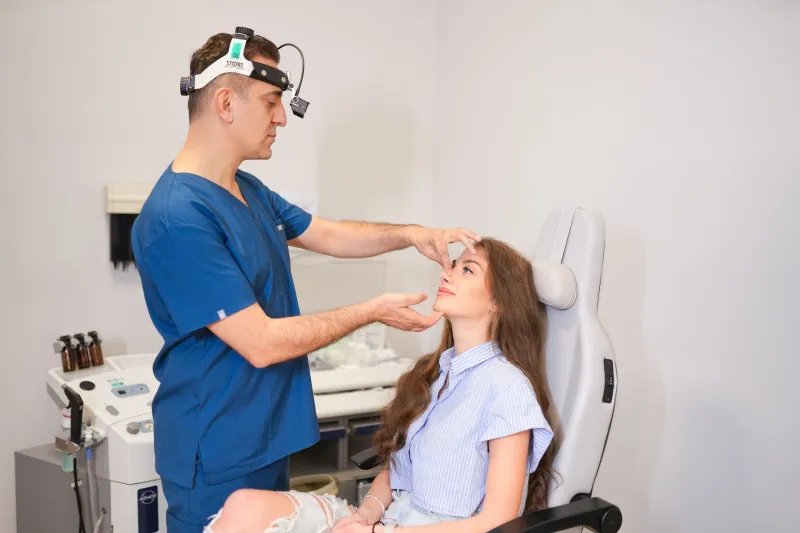
At Aoki Aesthetic Clinic, facial structure analysis is not a preliminary formality — it is the foundation of the entire treatment conversation. Before any procedure is discussed, the clinician maps the patient's face: the relationship between facial thirds, the angle of the jaw relative to the cheekbones, the position of the brow in relation to the orbital rim, the balance of upper and lower lip volume, the way light falls and shadows form across the midface.
This analysis is not about finding flaws. It is about understanding the architectural logic of a particular face so that any intervention enhances rather than disrupts that logic.
For patients accustomed to consultations that move quickly from what do you want to here's what we can do, this level of structural attention can feel unfamiliar. Some patients initially experience it as a delay. In practice, it is the step that prevents regret.
When Your Dream Result Looks Different — and Better — on Your Face
One of the more nuanced conversations in aesthetic medicine involves helping a patient understand that their ideal outcome may need to be translated, not abandoned.
A patient who arrives hoping to replicate the sharp, angular features of a particular actress may have a face that is naturally softer, rounder, and more balanced in its proportions. The clinical question is not whether to achieve definition, but where definition will create harmony on this face rather than visual tension. The result may be subtler than the inspiration image. It may also be more genuinely beautiful — because it is coherent with the patient's own structure rather than working against it.
This is a distinction that Japanese aesthetic medicine draws with particular clarity. The goal is never to produce a result that looks like it came from a procedure. The goal is to produce a result that looks like the patient — only more fully realized.
What to Ask Before Your Next Consultation
If you are preparing for an aesthetic consultation, consider shifting the framing of your goals. Rather than arriving with a fixed image of what you want, try arriving with a clearer sense of what bothers you and what you are hoping to feel differently about. Let the clinician's structural analysis inform how those concerns are addressed, not just whether they can be addressed.
The questions worth asking are not only can this be done but does this make sense for my face specifically. A skilled clinician should be able to explain, in plain terms, why a particular approach suits your anatomy — and equally, why a different approach might not, even if it has produced beautiful results elsewhere.
Be cautious of any consultation that skips this step. A practitioner who moves directly from your wish list to a treatment menu without pausing to analyze what your face actually needs is offering a service, not a clinical judgment. Those two things are not the same.
The Deeper Standard
Ultimately, the question of whether your aesthetic goals align with your facial structure is a question about whose face you are trying to improve. The answer, always, should be your own.
Japanese aesthetic medicine holds that the most technically excellent outcome is one that a patient's closest friends cannot quite name — they simply notice that the person looks well, rested, more themselves. That quality of seamless improvement is not accidental. It is the direct result of procedures chosen not for their popularity or their dramatic before-and-after potential, but for their precise compatibility with one specific face.
Your face is not a template. It is a starting point. The work of aesthetic medicine, done with integrity, is to honor its structure while elevating its expression — and that begins with the question most consultations never think to ask.