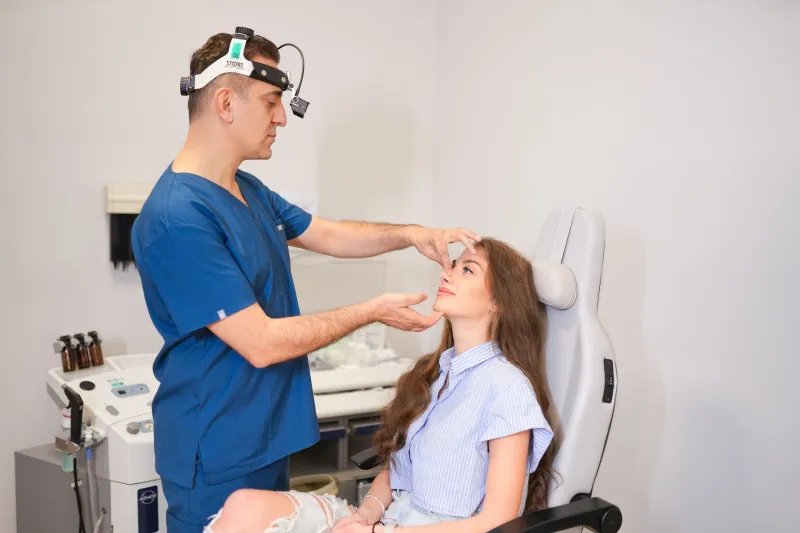
What the Doctor Sees Before You Finish Speaking: The Unspoken Language of the Aesthetic Consultation

Most patients arrive at an aesthetic consultation having rehearsed, at least mentally, what they intend to say. They have identified a concern, perhaps refined it over months of scrutiny in bathroom mirrors, and come prepared to describe it clearly. What they rarely anticipate is that a skilled physician has already begun forming clinical impressions before the first sentence is complete.
This is not a matter of rushing to conclusions. It is the product of disciplined observational practice — a cornerstone of Japanese aesthetic medicine, where restraint in intervention is matched by rigor in assessment. The consultation room, in this tradition, is less a place where problems are reported and more a space where the full picture of a person's face, bearing, and habitual expression is carefully read.
The Entrance as Clinical Data
The moment a patient walks through the door, information is already available to the attentive clinician. Posture communicates tension patterns that often manifest in the face. Someone who carries significant stress through the neck and shoulders frequently presents with corresponding hypertrophy of the masseter muscle, jaw clenching, or deepened lines along the lower face — details that bear directly on treatment planning, whether or not the patient mentions jaw discomfort.
The way a person moves through a space — how they hold their head, whether they favor one side when turning — can signal long-standing asymmetries that predated any aesthetic concern. These are not flaws to be corrected without discussion; they are structural realities that must be understood before any intervention is considered. A physician who notes a subtle head tilt before the patient has spoken is already thinking about the difference between a perceived asymmetry and an anatomical one, a distinction that changes everything about what a realistic outcome looks like.
What Movement Reveals That Stillness Cannot
Static photographs have their clinical uses, but they capture only one frozen frame of a face that is, in daily life, perpetually in motion. Experienced practitioners pay particular attention to the face as it moves — during conversation, while listening, even during moments of hesitation or reflection.
Habitual expressions are among the most diagnostically revealing phenomena in the consultation room. A patient who consistently raises one brow while speaking may be entirely unaware of the asymmetric dynamic lines forming above it. Someone who compresses their lips when thinking creates repeated muscular patterns that, over time, contribute to perioral lines in ways that differ substantially from those caused by volume loss. The treatment implications are different in each case, and neither can be fully appreciated from a chief complaint alone.
Natural smiling, in particular, deserves close attention. The aesthetic outcome a patient hopes to see when they smile is often at odds with the intervention they believe will produce it. Volume added in one area may shift the dynamics of a smile in ways that feel unfamiliar or undesirable. A physician who has observed the patient's natural smile — not posed for a photograph, but relaxed and genuine — can anticipate these dynamics and counsel accordingly.
Tension Patterns and What They Predict
Jaw tension is one of the most consistently underreported findings in aesthetic consultations. Many patients who present for concerns about lower facial heaviness, marionette lines, or a widened jawline have never connected these features to habitual clenching or grinding. They describe the appearance; they have not considered the mechanism.
When a physician notices the firmness of the masseter during a natural conversation — before any formal examination has begun — it opens a clinical pathway that the patient's stated concern might not have led to. Treatment that addresses only the surface appearance without acknowledging the underlying muscular pattern is likely to yield incomplete or short-lived results. The observation that happens before the patient has finished describing their concern may ultimately be the one that produces the most durable outcome.
Similarly, chronic tension around the eyes — the subtle but persistent contraction that occurs in people who squint frequently, whether from light sensitivity, screen fatigue, or habitual expression — tells a different story than the same periorbital lines in someone whose skin has simply thinned over time. The lines may look similar in a photograph. Their cause, and therefore their most appropriate treatment, may differ considerably.
The Asymmetry That Patients Have Learned to Ignore
Facial asymmetry is universal. No face is perfectly symmetrical, and the goal of aesthetic medicine is not to impose a symmetry that does not exist in nature. But there is a meaningful difference between the minor, inherent asymmetry that characterizes all human faces and the functional or positional asymmetry that develops over time through habit, dental history, sleeping position, or prior treatment.
Patients often adapt so thoroughly to their own asymmetries that they no longer perceive them consciously. They present with a concern — perhaps that one side of their face looks more tired, or that a feature appears uneven — without connecting it to the broader structural pattern a clinician can observe. When the physician notes, through careful observation during the consultation, that the asymmetry is most pronounced during a specific expression or at a specific angle, that finding reframes the entire conversation about what an intervention can and cannot achieve.
This is not a matter of discouraging the patient. It is a matter of building a treatment plan on accurate ground rather than on incomplete information.
Why Listening and Observing Are Not Competing Skills
None of this is to suggest that what a patient says matters less than what a physician observes. The patient's experience of their own face — what concerns them, what they have tried, what they hope for — is irreplaceable clinical information. The point is that these two streams of data are complementary, not competing.
At Aoki Aesthetic Clinic, the consultation is understood as a process of integration. What the patient articulates and what the physician observes together constitute the full clinical picture. When those two sources of information align, a treatment plan can be developed with confidence. When they diverge — when the stated concern does not fully account for what the physician is seeing — that divergence is itself informative, and addressing it openly is part of the physician's responsibility.
The most precise aesthetic outcomes are rarely the product of the most technically advanced procedures. They are the product of the most complete understanding of the individual in front of the physician — an understanding that begins, quietly and rigorously, the moment the patient enters the room.